Who's Who in Goldbach Research
A directory of researchers working on the Goldbach conjecture
Christian Goldbach (1690-1764) conjectured in a 1742 letter to Leonhard Euler that every even integer greater than 2 is the sum of two primes. The conjecture is still open.
This site is a reference directory of the researchers most active on the Goldbach conjecture and adjacent problems in additive prime number theory. It catalogs the Top 100, ranked from arXiv preprint output, OpenAlex citation data, and zbMATH classifications, gives their institutions, and provides a curated reading list of recent short papers.
Where to start
- Home: This page.
- The Top 100: the canonical ranked list, sortable and filterable in your browser.
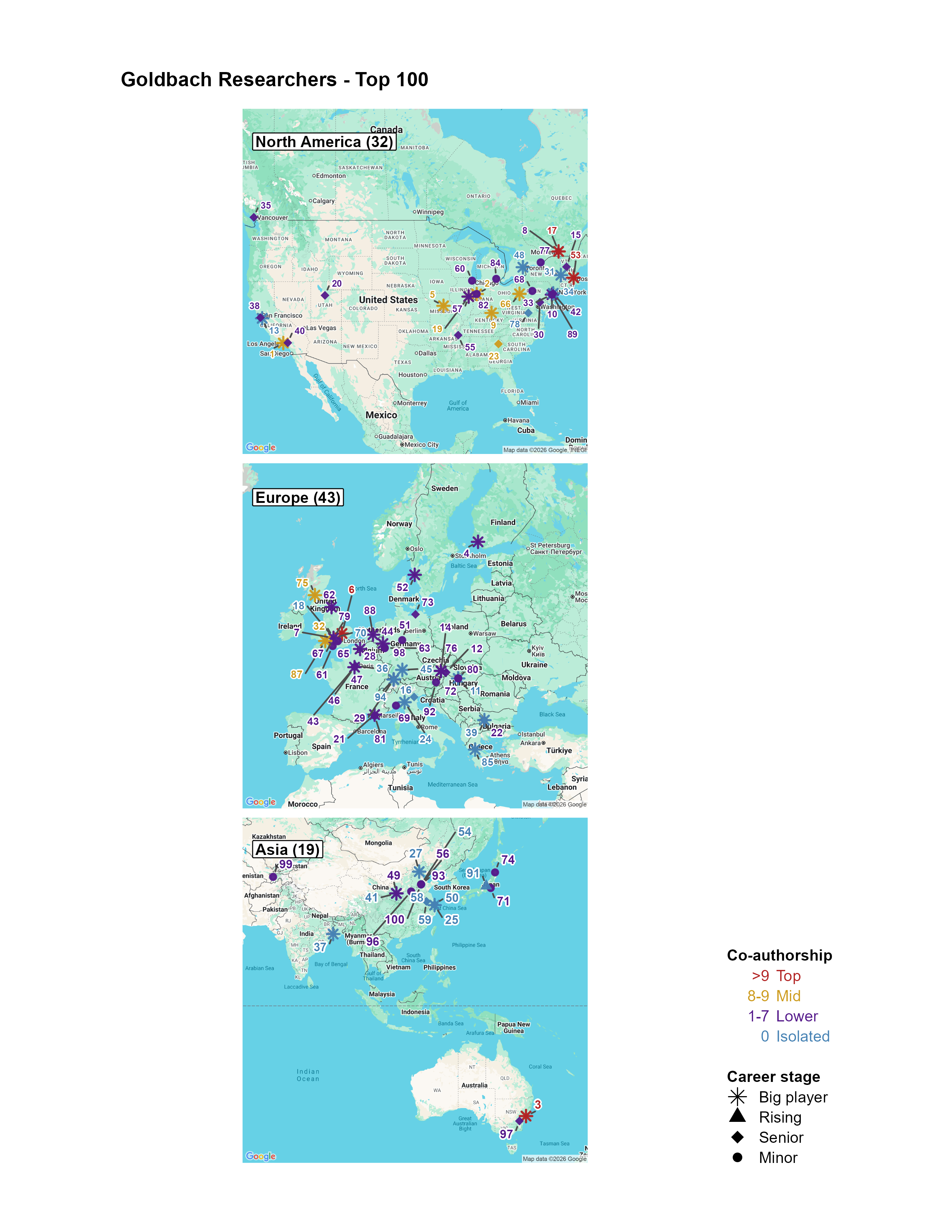
- Locations: where the Top 100 are based, shown by world region with maps.
- In Memoriam: researchers in this directory who are no longer with us.
- Genealogy: close relations of the Top 100 through advisor-student lineage in the Mathematics Genealogy Project.
- Network: the coauthorship graph among the Top 100: who has written papers with whom.
- Reading List: the recent topical papers ranked by the prominence of their authors in this directory, plus the most-cited papers of all time.
- Overlap: the researchers who also appear across the related conjecture sites.
- About: what this site is, who built it, and where to find the methodology, the open dataset, and how to request a correction.
How the list is built
Three independent signals are combined into one composite ranking:
- arXiv preprint output since 2003, filtered to math.NT and math.CO categories, matched against 17 Goldbach-relevant search terms.
- OpenAlex topical citations for the Goldbach phrases (
Goldbach conjecture,Goldbach problem,Goldbach's conjecture). - zbMATH Open, the curated mathematics review database, using the three Goldbach-core MSC subject classes (11P32 additive/Goldbach problems, 11P55 circle method, 11N36 sieve methods).
The three pipeline ranks are combined with a weighted order statistic. For each researcher the three ranks are sorted and weighted 70% on the best, 20% on the middle, and 10% on the worst, so being excellent in one Goldbach pipeline counts most, while strength across all three still wins overall. Lower is better. A researcher who appears in only one or two pipelines is not penalised; the missing rank is estimated from their nearest-ranked neighbours (the 70% weight only ever falls on a real, measured rank, never an estimate). False positives and off-topic authors are explicitly excluded by hand; the approach is described in the methodology.
The Mathematics Genealogy Project supplies advisor-student relationships for the separate genealogy view. It does not feed the ranking.
Citing this site
Hubbard, S. (2026). Who's Who in Goldbach Research. Zenodo. https://doi.org/10.5281/zenodo.20355375